Sunrise Photography Near Lima, Ohio
Some of the most rewarding photography mornings do not require a national park, a long flight, or weeks of planning. This series was made at Ottawa Metro Park in Lima, Ohio, only a short drive from home.
I arrived before sunrise because the most useful part of a sunrise session often begins while the landscape is still dim. The early arrival gave me time to walk to the lake, choose a position, set up the tripod, and study how the dock, shoreline, trees, mist, and open sky might work together.
My gear was simple: a Canon 5D Mark IV, a 24–105mm zoom lens, a tripod, and a polarizer. The camera and lens were familiar enough that I could make adjustments quickly without losing attention on the light.
Begin before the sun appears
I started at the dock just before sunrise. At that point, the strongest elements were not bright color but structure: the railings, the centered walkway, the still water, and the low mist across the far shoreline.
A tripod was important here. Before sunrise, the available light was limited, and the tripod allowed me to keep the image sharp without forcing the ISO unnecessarily high. It also slowed the process down. Once the camera was fixed in position, I could refine the symmetry and make sure the dock led directly into the calm lake.
.jpg)
View this Ottawa Metro Park print →
Sunrise tip: arrive 30–45 minutes early
Early arrival gives you time to work in blue hour, find foregrounds, level the tripod, clean the lens, and test exposures before the brightest color begins. It also prevents hurried decisions when the best light may last only a few minutes.
Use silhouettes to simplify a busy landscape
As the sun rose, the lake shifted from cool gray to warm gold. Rather than trying to preserve detail everywhere, I allowed grasses and shoreline plants to become silhouettes.
This simplified the lower part of the frame and kept attention on the mist, reflection, and sunrise. Exposing for the brightest area of sky prevented the sun and its reflection from losing all detail. A silhouette is not necessarily an exposure mistake; it can be an intentional way to organize the image.
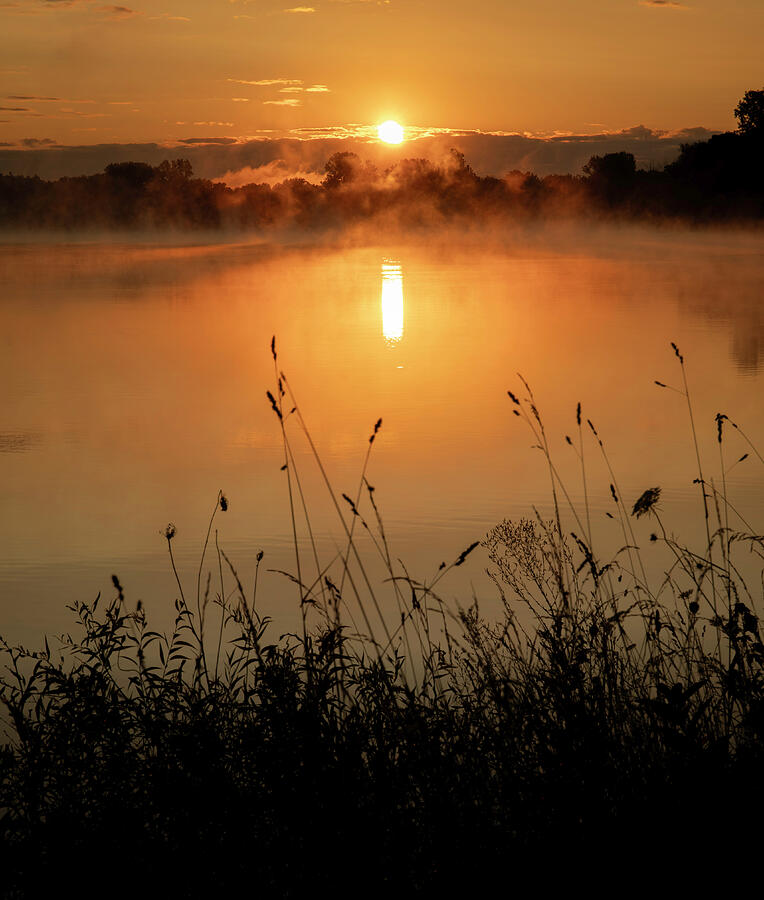
View this golden lake print →
Stay ready for the moment you cannot plan
The kayaker was the unexpected gift of the morning. I had already composed the lake, sunrise, and mist when the small figure entered the scene. There was no time to overthink it. I needed to adjust immediately.
I changed the framing to give the kayaker room to move through the photograph while keeping the sun away from the center. The rule of thirds helped organize the scene: the kayaker sat low in the frame, the horizon remained above the middle, and the brightest area balanced the moving subject.
The wake became an important compositional element. It provided a subtle line through the water and made the image feel active without destroying the quiet mood.
.jpg)
View the sunrise kayaker print →
Composition tip: leave room in front of movement
When a person, animal, boat, or vehicle enters the frame, avoid placing it against the edge it is moving toward. Give the subject visual space to travel into, then use the wake, reflection, or surrounding light to connect it with the larger landscape.
Know when color is not the point
Not every sunrise photograph needs to depend on orange or gold. The black-and-white lake reflection was processed intentionally because the image was really about shape, fog, symmetry, and quiet separation between the trees and water.
Removing color made the mist more noticeable and helped the reflected tree line merge with the actual shoreline. The result felt more timeless and restrained than the color version.
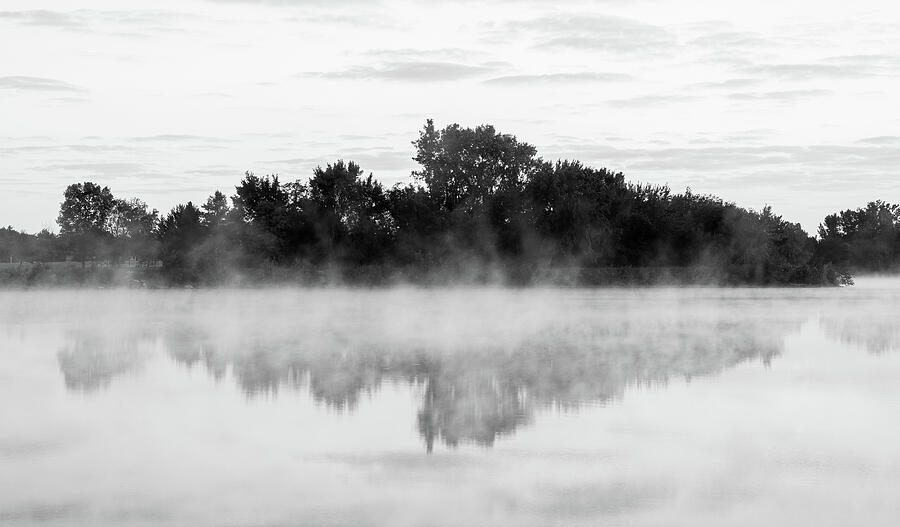
View the black-and-white lake print →
Keep photographing after the obvious moment
Once the sun had risen, it would have been easy to pack up. Instead, I walked slowly back toward the parking lot and continued watching how the light changed familiar parts of the park.
Along the lakeside path, the low sun passed through mature tree branches and illuminated the mist beyond the grass. The path created a natural leading line, while the large tree formed a frame around the sunrise.
.jpg)
View the misty path print →
The final photograph was beside the car
The last photograph came from a field near the parking area. The session could have been considered finished, but the sunlight caught the mist above the wildflowers and pulled my attention away from packing the gear.
The backlight made the moisture glow and separated the flowers from the darker vegetation. I composed through the field toward the trees, allowing the sun to sit high in the frame while the flowers carried the foreground.
This image became a useful reminder: photographers often assume the strongest subject must be far away. Sometimes the best light is beside the car, along the path home, or in a place we have driven past many times.
.jpg)
View the wildflower sunrise print →
How I used the polarizer
A circular polarizer can help manage glare on foliage and water, but it needs to be used carefully around sunrise. Maximum polarization is not always desirable. Too much can remove the reflections and surface glow that make a misty lake feel luminous.
I rotated the polarizer while looking through the viewfinder and stopped when the balance felt right. The goal was not to eliminate every reflection. It was to control glare while preserving the warmth, mist, and visual depth of the water.
A practical starting point for sunrise camera settings
Exact settings depend on wind, focal length, available light, and whether anything in the frame is moving. These are useful starting points rather than rigid rules:
- Before sunrise on a tripod: ISO 100–400, aperture around f/8 to f/11, and whatever shutter speed creates a correct exposure.
- When mist or foliage is moving: raise ISO enough to keep the shutter speed from becoming excessively long.
- When a kayaker or wildlife appears: prioritize a faster shutter speed and increase ISO if necessary.
- For the sun and reflection: check the histogram and protect important highlights from clipping.
- For reliable color: photograph in RAW so white balance can be refined later without damaging the file.
- To reduce vibration: use a cable release, remote, or two-second self-timer when the camera is on the tripod.
Finding photography locations around Lima and Northwest Ohio
Northwest Ohio does not have ocean cliffs or towering mountain ranges, but it offers its own strengths: fog, wetlands, reservoirs, open fields, tree lines, wildlife, farmland, and broad eastern skies.
For photographers searching for Lima, Ohio photography locations, the most important factor is often not the size of the landscape but the timing. A familiar park can look completely different when cool overnight air produces mist and the first sunlight arrives at a low angle.
Return to the same nearby places in different seasons. Watch for frost, spring fog, summer wildflowers, autumn color, winter ice, and changing water levels. Familiarity helps you anticipate where the light will fall and where a subject may enter the frame.
More regional work can be found on my Lima, Ohio fine-art photography page and in my broader collection of Ohio nature photography prints.
Final thoughts
This Ottawa Metro Park sunrise produced six very different photographs from one short morning: a symmetrical dock, a golden silhouette, an unexpected kayaker, an intentionally monochrome reflection, a sunlit lakeside path, and a field glowing beside the parking lot.
None of them came from rushing directly to the brightest color and leaving as soon as the sun appeared. They came from arriving early, staying observant, adapting when the scene changed, and continuing to look during the walk back.
That is the larger lesson for sunrise photography in Lima, Northwest Ohio, or anywhere else: preparation creates opportunity, but attention is what recognizes the moment.