British Columbia Road Trip · September 2026

10-day British Columbia road trip: Sea-to-Sky, Vancouver Island, Ucluelet & Tofino.

This is the route we actually drove from Seattle into British Columbia—through Squamish and Pemberton, across to Vancouver Island, north to Campbell River, then west through old-growth forest to Ucluelet and Tofino. It is written primarily as a practical travel guide, with the lodging, ferry strategy, stops, mistakes, and places I would recommend to someone planning a similar trip.

The trip at a glance

A nature-first route that skips the usual city-heavy British Columbia itinerary.

We traveled from September 16–26, 2026, flying into Seattle, renting a vehicle, and entering Canada by road. Rather than spending most of the trip in Vancouver or Victoria, we built the route around mountains, waterfalls, rainforest, wildlife, rugged coastline, beaches, small towns, and scenic drives.

The result was a loop that connected the Sea-to-Sky corridor with several very different parts of Vancouver Island. We moved quickly at first—Squamish, Pemberton, North Vancouver, Nanaimo, Campbell River, and Courtenay/Comox—then deliberately slowed down for three nights in Ucluelet. That change of pace made the final part of the trip much better.

If your priorities are scenery, short hikes, waterfalls, wildlife, beaches, small towns, and time outdoors, this route is a strong alternative to a traditional Vancouver–Victoria vacation. It is also easy to lengthen by adding a night in Squamish, Campbell River, Comox, Tofino, or Victoria.

Quick trip facts

Trip length10 days · September 16–26, 2026
Start / finishSeattle / SeaTac with a rental vehicle
FerriesHorseshoe Bay → Nanaimo and Swartz Bay → Tsawwassen
Favorite baseUcluelet · three nights at Terrace Beach
Favorite beachLong Beach in Pacific Rim National Park Reserve
Standout experiencesPemberton Meadows, Paradise Meadows, Strathcona, Wild Pacific Trail and the rainforest
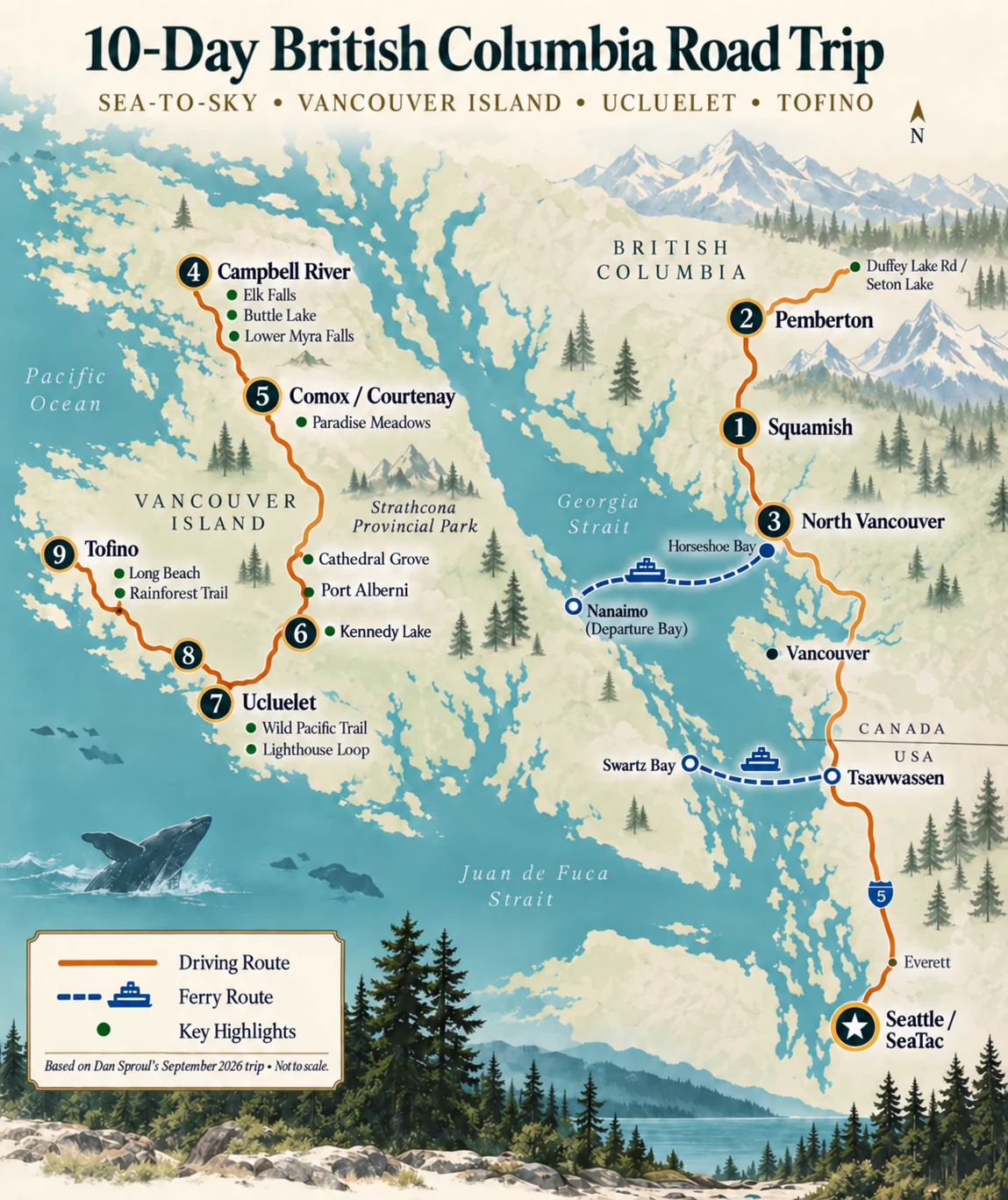
Illustrated route map of a 10-day British Columbia road trip from Seattle through Squamish, Pemberton, Vancouver Island, Ucluelet and Tofino.
Our route at a glance: Seattle to Squamish and Pemberton, across to Vancouver Island, north to Campbell River and Comox, then west through Kennedy Lake to Ucluelet and Tofino before returning via Swartz Bay and Tsawwassen.
How fast is this route?

It worked for us because we are comfortable starting early and changing hotels often. If you prefer slow mornings, long meals, or fewer driving days, add two or three nights. The easiest places to add time are Squamish, Campbell River/Strathcona, Ucluelet/Tofino, or Victoria.

Day-by-day itinerary

How we combined the Sea-to-Sky Highway with Vancouver Island.

This is based on our actual route. I have kept the photography side secondary so it works as a trip-planning guide even if your camera is just a phone.

Day 1

Seattle to Squamish: Sea to Sky Gondola and the estuary

We picked up our rental vehicle in Seattle, crossed into Canada, and continued north toward Squamish. Squamish immediately felt like the right first stop because it gives you dramatic mountain scenery without forcing you into a long first day all the way to Whistler or Pemberton. Our main activity was the Sea to Sky Gondola, where the summit views over Howe Sound, the surrounding mountains, and coastal forest gave us a quick introduction to the scale of the region.

The Squamish Estuary was the quieter counterpoint. It is flat, easy to walk, and gives broad views toward the Stawamus Chief and the mountains without requiring another major hike. For travelers who arrive with only an hour or two of daylight left, I would absolutely keep the estuary on the list—it feels peaceful, close to town, and much more scenic than simply going back to the hotel.

Staying downtown also made the first evening easy. We could settle in, walk for food or coffee, and still be positioned for an early start the next morning.

Stay: August Jack Motor Inn · Main stops: Sea to Sky Gondola + Squamish Estuary · Pace: easy first day
Squamish Estuary. The quieter side of Squamish, with open wetlands and the Stawamus Chief filling the background.View photograph / print →Click image to enlarge
Day 2

Squamish to Pemberton: Nairn Falls, Pemberton Meadows and bears

We continued north through Whistler country to Pemberton. Nairn Falls is easy to build into this drive because the park is only a few minutes from Pemberton and the main viewpoint is reached by a roughly 1.5-kilometre trail. The falls are powerful and the trail follows the Green River through forest rather than feeling like a roadside photo stop.

Pemberton Meadows was one of the most beautiful surprises of the mainland portion. The valley opens into farmland with huge mountains rising behind it, and the slower rural roads make it a place to wander rather than race through. We stayed out into the evening because the light kept improving and the whole area felt calmer than Whistler.

We also had one of the most memorable wildlife days of the entire trip here, seeing multiple bears in the broader Pemberton area. That was extraordinary luck, not something I would promise anyone planning the route. If you do encounter bears, stay in the vehicle or keep a very large distance, avoid blocking traffic, and never approach them for a photo.

Stay: Pemberton Hotel · Best easy hike: Nairn Falls · Best relaxed drive: Pemberton Meadows · Wildlife is a bonus, never a guarantee
Pemberton Meadows wildlife. One of the extraordinary bear encounters we had in the valley; wildlife sightings are never guaranteed.View photograph / print →Click image to enlarge
Day 3

Duffey Lake Road, Seton Lake, then back to North Vancouver

This was one of our longest mainland sightseeing days. From Pemberton we followed Highway 99 onto the Duffey Lake Road, stopping around Wally Creek, Duffey Lake, the Cayoosh Summit area, and Seton Lake. The road changes quickly from forested mountain valleys to drier interior scenery, which makes the drive feel much bigger than the mileage suggests.

After reaching Seton Lake we backtracked toward the Vancouver area and stayed in North Vancouver. That is not the most fuel-efficient way to structure the route, but it let us see the Duffey Lake corridor while still positioning ourselves close enough for an early Horseshoe Bay ferry the next morning. If you dislike backtracking, you could redesign this portion as a separate mainland loop or add another night.

Stay: Econo Lodge Inn & Suites North Vancouver · Scenic priority: Duffey Lake Road · Logistics priority: stage for ferry
Duffey Lake. A calm mountain-lake stop along one of the most scenic driving portions of the mainland route.View photograph / print →Click image to enlarge
Highway 99 near Seton Lake. The landscape becomes drier and more dramatic as the road approaches Lillooet.View photograph / print →Click image to enlarge
Day 4

Horseshoe Bay ferry to Nanaimo, then north to Campbell River

We took an early BC Ferries sailing from Horseshoe Bay to Nanaimo's Departure Bay. An early ferry is worth the effort because it gives you most of the day on Vancouver Island instead of sacrificing a travel day. From Nanaimo we worked our way north, including a waterfall stop at Little Qualicum Falls before continuing to Campbell River.

Campbell River is a useful base because it gives you access to both the coast and Strathcona Provincial Park. We also visited Elk Falls, where a short walk leads to the waterfall and suspension bridge. But one of the biggest surprises happened right along the Campbell River waterfront: while spending time near the pier we saw an orca moving through Discovery Passage. It was completely unplanned and became one of those travel moments that matters more because you were not chasing it. Even without an orca sighting, I would still build in time to walk the shoreline, watch for seals and seabirds, and simply look out across the passage.

Stay: Big Rock Motel · Ferry: Horseshoe Bay → Departure Bay · Stops: Little Qualicum Falls + Elk Falls
Coastal light on Vancouver Island. Ferry and waterfront days can be scenic in their own right, especially when the weather breaks.View photograph / print →Click image to enlarge
Vancouver Island wildlife. A close-looking portrait made with a telephoto lens while keeping a safe distance.View photograph / print →Click image to enlarge
Day 5

Strathcona Provincial Park: Buttle Lake and waterfalls

We dedicated a full day to Strathcona Provincial Park from Campbell River. This was one of the easiest days to underestimate on a map. Highway 28 gets you into the park, but once you are around Buttle Lake the stops spread out and the drive becomes part of the experience.

We visited Buttle Lake, Lower Myra Falls, Lupin Falls, and Lady Falls. Lower Myra Falls is especially rewarding because the trail is short but the cascades are visually dramatic. Bring food, water, and enough fuel before heading deep into the park; services are limited once you leave Campbell River.

Stay: Big Rock Motel · Full-day nature excursion · Bring fuel, water and lunch
Lower Myra Falls. One of the most rewarding short waterfall hikes of our Strathcona day.View photograph / print →Click image to enlarge
Buttle Lake. A spontaneous moment that shows the scale of the lake and surrounding mountains.View photograph / print →Click image to enlarge
Day 6

Paradise Meadows, Lake Helen Mackenzie and Comox

We shifted south into the Comox Valley and explored the Paradise Meadows side of Strathcona Provincial Park. This ended up being one of my favorite hiking areas of the trip. The landscape feels completely different from Buttle Lake: higher elevation, long boardwalk sections, ponds, subalpine meadows, mountain views and pockets of early fall color. In late September the reds and golds beginning to move through the meadow vegetation made the walk especially beautiful.

The easiest option is to spend time around Paradise Meadows itself, but we continued farther toward Lake Helen Mackenzie. BC Parks lists the Paradise Meadows loop at 4.2 km and the Helen Mackenzie/Battleship Lake loop at 8 km, so this area works whether you want a gentle walk or a more substantial half-day hike.

Comox made a nice change of pace afterward. We spent time around the marina and coastline, including Goose Spit, and enjoyed how quickly the day shifted from subalpine mountain scenery to salt water. The Holiday Inn Express & Suites Courtenay–Comox gave us a comfortable reset before the drive across the island the next morning.

Stay: Holiday Inn Express Courtenay–Comox · Highlight: Paradise Meadows in early fall color · Best contrast: alpine morning + coastal evening
Paradise Meadows in early fall. Subalpine color was just beginning to turn during our September visit.View photograph / print →Click image to enlarge
Comox Harbour. A peaceful coastal contrast after hiking the higher-elevation meadows.View photograph / print →Click image to enlarge
Day 7

Cathedral Grove, Port Alberni and Highway 4 to Ucluelet

This was one of my favorite driving days because the scenery changes repeatedly. We stopped at Cathedral Grove in MacMillan Provincial Park, where enormous old-growth Douglas fir trees make an easy roadside stop feel much more substantial than its location suggests. From there we continued through Port Alberni and onto Highway 4 toward the west coast.

Highway 4 is beautiful but deserves time. Parks Canada describes the section west of Port Alberni as steep and twisting; the drive toward Pacific Rim is not something I would schedule tightly. We stopped around Taylor River, Wally Creek, Kennedy River, and Kennedy Lake before finally reaching Ucluelet.

This is where I would intentionally stop changing hotels. Three nights at The Cabins at Terrace Beach gave us a real base instead of another overnight stop.

Stay: The Cabins at Terrace Beach · Route: Highway 4 · Best planning choice: three nights in one place
Cathedral Grove. Huge old-growth trees turn an easy roadside stop into one of the most memorable forest walks on the route.View photograph / print →Click image to enlarge
Kennedy Lake. Moody weather suited the drive across Highway 4 toward the west coast.View photograph / print →Click image to enlarge
Day 8

Ucluelet: Lighthouse Loop, harbor wildlife and the Wild Pacific Trail

Ucluelet deserves its own day instead of being treated only as a cheaper place to sleep near Tofino. We explored Big Beach, the Wild Pacific Trail, Amphitrite Lighthouse, the harbor, and the area around the Ucluelet Aquarium. The Wild Pacific Trail was one of our favorite easy walks of the entire trip because it combines rainforest, rocky shoreline, viewpoints, and open-ocean scenery without requiring a difficult hike.

I especially liked hiking the Lighthouse Loop in the morning. The official trail information emphasizes its dramatic coastal viewpoints, and from our experience the softer morning light made the lighthouse and shoreline feel quieter and more atmospheric before the day got moving. The loop is roughly 2.5 kilometres, but we spent much longer because almost every bend offered another place to stop.

Later, around Ucluelet Harbour near the aquarium, we watched sea lions along the waterfront. That was another reminder not to schedule every minute. The aquarium itself is focused on local Barkley and Clayoquot Sound marine life, and the surrounding harbor is worth walking even if you do not go inside.

This is also where staying at Terrace Beach paid off: the trail and shoreline were part of the immediate surroundings rather than another long drive.

Stay: The Cabins at Terrace Beach · Best easy walk: Lighthouse Loop in the morning · Wildlife bonus: harbor sea lions
Wild Pacific Trail. Morning and changing storm light made this one of our favorite walks in Ucluelet.View photograph / print →Click image to enlarge
Big Beach. Rugged shoreline and moving water within easy reach of town.View photograph / print →Click image to enlarge
Ucluelet Harbour. We watched sea lions around the waterfront near the aquarium.View photograph / print →Click image to enlarge
Day 9

Pacific Rim National Park Reserve, Long Beach and Tofino

We used Ucluelet as our base for a full day north toward Tofino. Stops included Pacific Rim National Park Reserve, Long Beach, the rainforest trails, Radar Hill, Chesterman Beach, and Tofino itself. This is one of those areas where a packed checklist works against you; weather, tides, surf, and changing light make it better to choose a few places and spend real time there.

Long Beach was our favorite beach of the trip. It feels enormous, with enough space that the coast still feels wild even though it is one of the best-known stops in Pacific Rim. We walked rather than treating it as a ten-minute viewpoint, and that made a big difference. Parks Canada notes that the Long Beach Unit contains about 22 km of beaches, so this is a place where giving yourself extra time is easy to justify.

The rainforest hikes were just as memorable. The Rainforest Trails move through old-growth temperate rainforest on boardwalks and stairs, with huge trees, moss, ferns and a sense of enclosure that is the complete opposite of the beach. Parks Canada lists Rainforest Trail A as a 1 km loop with boardwalk and many stairs, making it short enough to combine with Long Beach on the same day.

We also made time for Tofino without turning the day into shopping and restaurants. A quick meal at Tacofino worked well because it kept the focus on the coast rather than building the entire day around reservations.

Stay: The Cabins at Terrace Beach · Our favorite beach: Long Beach · Do not skip the rainforest trails
Long Beach. Our favorite beach of the trip: huge, open, windswept and worth far more than a quick stop.View photograph / print →Click image to enlarge
Pacific Rim rainforest. The forest hikes were every bit as memorable as the beaches and made the west coast feel completely different.View photograph / print →Click image to enlarge
Day 10

Ucluelet to Swartz Bay, ferry to Tsawwassen, then SeaTac

This was the hardest transit day of the trip. We left the west coast of Vancouver Island, drove toward Swartz Bay, took the ferry to Tsawwassen, crossed back into the United States, and continued to a hotel near SeaTac for our flight the next morning.

It worked, but I would only recommend this version if you are comfortable with a long travel day and have a late-enough ferry reservation. A more relaxed itinerary would add a night near Victoria or somewhere farther south on Vancouver Island. The benefit of our approach was waking up near the airport instead of worrying about a border crossing, ferry, and flight all on the same morning.

Stay: Hilton Garden Inn Seattle Airport · Ferry: Swartz Bay → Tsawwassen · Longest logistics day
Return-flight strategy

Our flight home was the following morning. Sleeping near SeaTac after the ferry and border crossing was a good decision. It removed several things that could have gone wrong on flight day and let us return the rental vehicle and use the hotel/airport logistics without rushing.

What made the trip memorable

The stops I would make time for again—not just the famous ones.

The route worked because some of the best experiences were not major attractions. These are the moments I would protect when planning a similar trip.

Squamish

Walk the estuary, not just the gondola.

The Sea to Sky Gondola delivers the big view, but the estuary gave us the quieter side of Squamish—flat trails, open water, mountain views and room to slow down after driving.

Estuary trail information ↗
Pemberton

Pemberton Meadows deserves an evening.

The farmland and mountain backdrop were beautiful enough that we stayed out longer than planned. Seeing bears in the broader area made the day unforgettable, but the valley itself would have been worth the drive without wildlife.

Campbell River

Leave time for the waterfront.

We came for Elk Falls and Strathcona, but seeing an orca from the Campbell River pier became one of the trip's defining memories. Walk the shore and watch the passage even when you have no wildlife tour booked.

Comox Valley

Paradise Meadows changes the feel of the island.

Boardwalks, subalpine lakes, mountain views and early fall color made Paradise Meadows feel completely different from the coast. It is one of the easiest places on this route to add either a short walk or a half-day hike.

Paradise Meadows trails ↗
Ucluelet

Walk Lighthouse Loop early.

Morning was our favorite time on the loop. The light felt softer, the trail quieter and the coastline more atmospheric. Later in the day, spend time around the harbor too.

Wild Pacific Trail ↗
Ucluelet Harbour

Look for life around the aquarium and docks.

We saw sea lions around the harbor near the Ucluelet Aquarium. Even without a sighting, the waterfront is a worthwhile walk and the aquarium gives useful context for the marine life of Barkley and Clayoquot Sounds.

Ucluelet Aquarium ↗
Pacific Rim

Long Beach was our favorite.

Of all the beaches we visited, Long Beach was the one we would most want to return to. Its scale, surf and open horizon made it feel like the visual centerpiece of the west-coast portion of the trip.

Long Beach Unit hiking ↗
Pacific Rim

The rainforest hikes are not filler.

The boardwalks, giant trees, moss and ferns were every bit as memorable as the beaches. Pairing rainforest and shoreline on the same day is one of the reasons this part of Vancouver Island feels so distinctive.

Pacific Rim rainforest ↗

Where we stayed

Our British Columbia lodging, with the places I would recommend again.

These reviews are intentionally practical. A road-trip hotel does not need to be a resort; sometimes location, parking, an early start, and a comfortable room matter more.

Pemberton · Simple and convenient

Pemberton Hotel

The Pemberton Hotel is a straightforward, older-style hotel in the center of town. That was exactly what we needed for one night. Restaurants, coffee, groceries and gas are nearby, and the location is convenient for Nairn Falls, Pemberton Meadows and the start of the Duffey Lake Road.

I would choose it again for a short Pemberton stay because the point here is not to spend the day in the hotel. It is a practical base that keeps you close to the landscape without Whistler pricing.

Best for: an affordable overnight between Whistler/Squamish and the Duffey Lake Road.

North Vancouver · Ferry staging night

Econo Lodge Inn & Suites North Vancouver

We used North Vancouver primarily as a staging point for the early Horseshoe Bay ferry. That is the right way to think about this stay: not as a destination hotel, but as a practical night that makes the next morning easier.

For our route, being on the North Shore meant we could avoid crossing all of Metro Vancouver before sunrise. If your ferry is early, I would strongly consider doing the same rather than staying downtown Vancouver.

Best for: travelers with an early Horseshoe Bay departure who value convenience over scenery.

Campbell River · Waterfront value

Big Rock Motel

Big Rock Motel is simple, but the location is the reason I liked it. It sits along the Campbell River waterfront near the Sea Walk, with Discovery Passage directly across the road. That made it easy to step outside and feel connected to the coast instead of staying in a generic highway hotel.

We used it for two nights while exploring Elk Falls and Strathcona Provincial Park. It is not a luxury property, but for a road trip it gave us what mattered: a useful location, parking, coastal views, and an easy base for early starts.

Best for: budget-conscious travelers who want the waterfront and quick access to Campbell River and Strathcona.

Courtenay / Comox · Comfortable reset

Holiday Inn Express & Suites Courtenay–Comox

After several nights of moving quickly, this was a comfortable reset. The hotel is modern, easy to access, and well positioned for the Comox Valley, Paradise Meadows and Mount Washington. Complimentary breakfast and parking also make sense on a road trip because they simplify the next morning.

I would stay here again if I wanted a predictable, comfortable hotel between Campbell River and the west-coast drive toward Ucluelet.

Best for: travelers who want modern comfort, breakfast and a central Comox Valley location.

SeaTac · Final-night logistics

Hilton Garden Inn Seattle Airport

For the last night, convenience mattered more than scenery. The Hilton Garden Inn is less than a mile from Sea-Tac and offers an airport shuttle, which made it a strong choice after a long ferry, border and driving day.

Staying near the airport the night before the flight removed a lot of stress from the end of the trip. I would make the same choice again rather than trying to connect an island ferry directly to a morning flight.

Best for: a low-stress final night before an early SeaTac departure.
BC Ferries

The ferry strategy that made this route work.

For a road trip with a rental vehicle, ferry timing matters almost as much as hotel location.

Horseshoe Bay → Nanaimo

We used an early sailing so we still had most of the day on Vancouver Island. As of October 2026, BC Ferries says vehicle customers traveling from Horseshoe Bay to Nanaimo Departure Bay must book and pay in advance. Check the current rule before your trip.

Official terminal information →

Swartz Bay → Tsawwassen

We used this route to leave Vancouver Island and continue south toward Seattle. BC Ferries currently recommends arriving 30–60 minutes before a booked sailing; missing the booking window can mean losing your reserved space.

Official terminal information →

Do not connect ferry + flight tightly

Weather, traffic, border waits and ferry loading all introduce variables. Our solution was simple: complete the ferry and border crossing the day before flying home, then sleep near SeaTac.

Where to base yourself

Ucluelet or Tofino? I would stay in Ucluelet again.

Both are worth visiting, but they offer different experiences. For this route, Ucluelet fit us better.

Why Ucluelet worked for us

  • Quieter evenings and a more relaxed feel.
  • Immediate access to the Wild Pacific Trail and Amphitrite Lighthouse.
  • Big Beach, harbor walks and rugged shoreline right in town.
  • A good base for Pacific Rim National Park Reserve without sleeping in the busiest area.
  • The Cabins at Terrace Beach made the lodging itself part of the experience.

Why you should still spend a day in Tofino

  • Easy access to Long Beach—our favorite beach of the trip—Chesterman Beach and the northern side of Pacific Rim.
  • More restaurants, shops, surf culture and tourism services.
  • Excellent choice if dining and town atmosphere are as important as hiking and quiet.
  • Worth visiting even if you sleep in Ucluelet.
Our sweet spot: three nights

Three nights let us devote one day to Ucluelet, one day to Pacific Rim and Tofino, and still have arrival/departure time without feeling as though every hour had to be scheduled.

Practical planning

What I would tell someone before they drive this route.

Reserve ferries early

Do not assume you can simply arrive with a vehicle. Check the exact BC Ferries route and reservation rules before locking in hotel dates.

Fuel before remote drives

Fill up before the Duffey Lake Road, deep Strathcona days, and the Highway 4 west-coast drive. Services become less frequent once you leave the main towns.

Build in weather flexibility

Rain, fog and low cloud are part of coastal British Columbia. A waterproof shell and shoes you do not mind getting wet are more valuable than an overpacked wardrobe.

Do not rush Highway 4

The road west from Port Alberni is winding, scenic and worth stopping along. Parks Canada advises allowing ample time; our stops made it an experience rather than a transfer.

Stay longer on the west coast

If you are moving every night early in the trip, give yourself at least three nights in Ucluelet or Tofino. It creates a needed reset.

Start major park days early

Strathcona, Pacific Rim and the Sea-to-Sky corridor all become easier when you reach the first trail or viewpoint before the busiest part of the day.

Watch wildlife from distance

We saw bears and marine wildlife, but sightings should be treated as a bonus. Never stop unsafely or approach animals for a photograph.

Keep one easy day

Comox and Ucluelet both worked well as lower-intensity days after several hikes and long drives. A good itinerary needs recovery time too.

Photography notes

A few camera lessons—but this trip works even without a photography agenda.

I traveled with dedicated camera gear, but most of the best travel advice is the same whether you carry a phone or a full landscape kit: start early, slow down, and leave room for weather.

Squamish & Sea-to-Sky

Morning and late-day light help with the huge contrast between dark forest, mountains and sky. The gondola gives you several viewpoints without a major hike.

Waterfalls

Nairn Falls, Elk Falls and Lower Myra Falls all reward slower shutter speeds, but a tripod is optional if your main goal is travel rather than technical waterfall photography.

Wildlife

A telephoto lens is useful in bear country and along the coast, but the best wildlife photograph is always the one made without changing the animal's behavior or putting yourself near traffic.

Rainforest

Overcast weather is ideal for Cathedral Grove and rainforest trails. It reduces contrast and makes wet greens, moss and tree bark look richer.

Ucluelet coast

The Wild Pacific Trail has enough viewpoints that you do not need one perfect location. Wind, surf and fog can completely change the scene within an hour.

Beaches

On the west coast, tide and weather matter more than a rigid shot list. Check conditions and never turn your back on the ocean for a photograph.

British Columbia road trip FAQ

Questions I would have wanted answered before the trip.

Is 10 days enough for this route?

Yes, if you are comfortable moving frequently. The first six days are active and involve several hotel changes. If you prefer a slower vacation, add two or three nights—ideally one in Squamish or Pemberton, one around Campbell River/Strathcona, and one on Vancouver Island's west coast.

Would you stay in Ucluelet or Tofino?

I would stay in Ucluelet again. It gave us a quieter base, excellent access to the Wild Pacific Trail, and a short enough drive to spend a full day in Tofino and Pacific Rim National Park Reserve. Travelers who prioritize restaurants, shopping and surf-town energy may prefer Tofino.

What were the best lodging choices?

August Jack Motor Inn in Squamish was one of the strongest practical one-night bases, while The Cabins at Terrace Beach in Ucluelet was the standout multi-night stay. Those two properties matched their locations especially well.

Do I need to reserve BC Ferries?

For our route, yes. BC Ferries currently requires vehicle travelers from Horseshoe Bay to Nanaimo Departure Bay to book and pay in advance. Other routes have different rules, so use BC Ferries directly rather than relying on an old travel blog.

How difficult is the drive to Ucluelet and Tofino?

Highway 4 west of Port Alberni is paved but winding, with steep sections and frequent changes in speed. It is not a technically difficult drive in normal conditions, but it takes concentration and should not be rushed. Give yourself extra time for stops and slower traffic.

Do you need an SUV?

Not for the main route described here. The principal highways, hotel access and major park trailheads we used are accessible by regular passenger vehicle in normal conditions. We liked having a larger vehicle for luggage and camera gear, but four-wheel drive was not the reason this itinerary worked.

Is September a good time for this trip?

It was a very good fit for us. Conditions can be cool and wet, but the shoulder season suited a nature-focused itinerary. Pack layers and waterproof outerwear, and check seasonal operating hours before assuming every visitor service is open daily.

What stops would you make sure not to skip?

For our style of trip: Squamish Estuary, Pemberton Meadows, Paradise Meadows, Campbell River's waterfront, the Lighthouse Loop in Ucluelet, Long Beach, and at least one of Pacific Rim's rainforest trails. Those places gave the trip much more variety than simply moving between the best-known viewpoints.

Bring a piece of British Columbia home.

Many of the original photographs throughout this guide—from mountain lakes and rainforest to wildlife and the rugged Vancouver Island coast—are available as finished wall art and prints.

Explore Dan Sproul Photography Prints →

About this guide

Based on the trip we actually took.

I am Dan Sproul, a fine art landscape and nature photographer based in Lima, Ohio. My travel guides are built from routes I have personally driven and places I have actually visited, then organized to be useful to travelers rather than only as photography journals.

This British Columbia itinerary reflects our September 2026 trip. Ferry policies, park access, fees, hotel offerings and seasonal hours can change, so I have linked to official sources throughout the guide where current information matters.

More about Dan Sproul →